
Paul Cézanne’s The Card Players: How Repetition Became Discovery

Paul Cézanne’s The Card Players holds a noisy pastime in almost complete silence. Painted in 1890–92 in oil on canvas, the four-figure version now in The Metropolitan Museum of Art turns a village card game into a study of weight, balance, and attention. Three men sit around a plain table while a fourth watches, pipe in mouth. Nothing dramatic happens, yet every hat, sleeve, chair, and card feels deliberately placed.
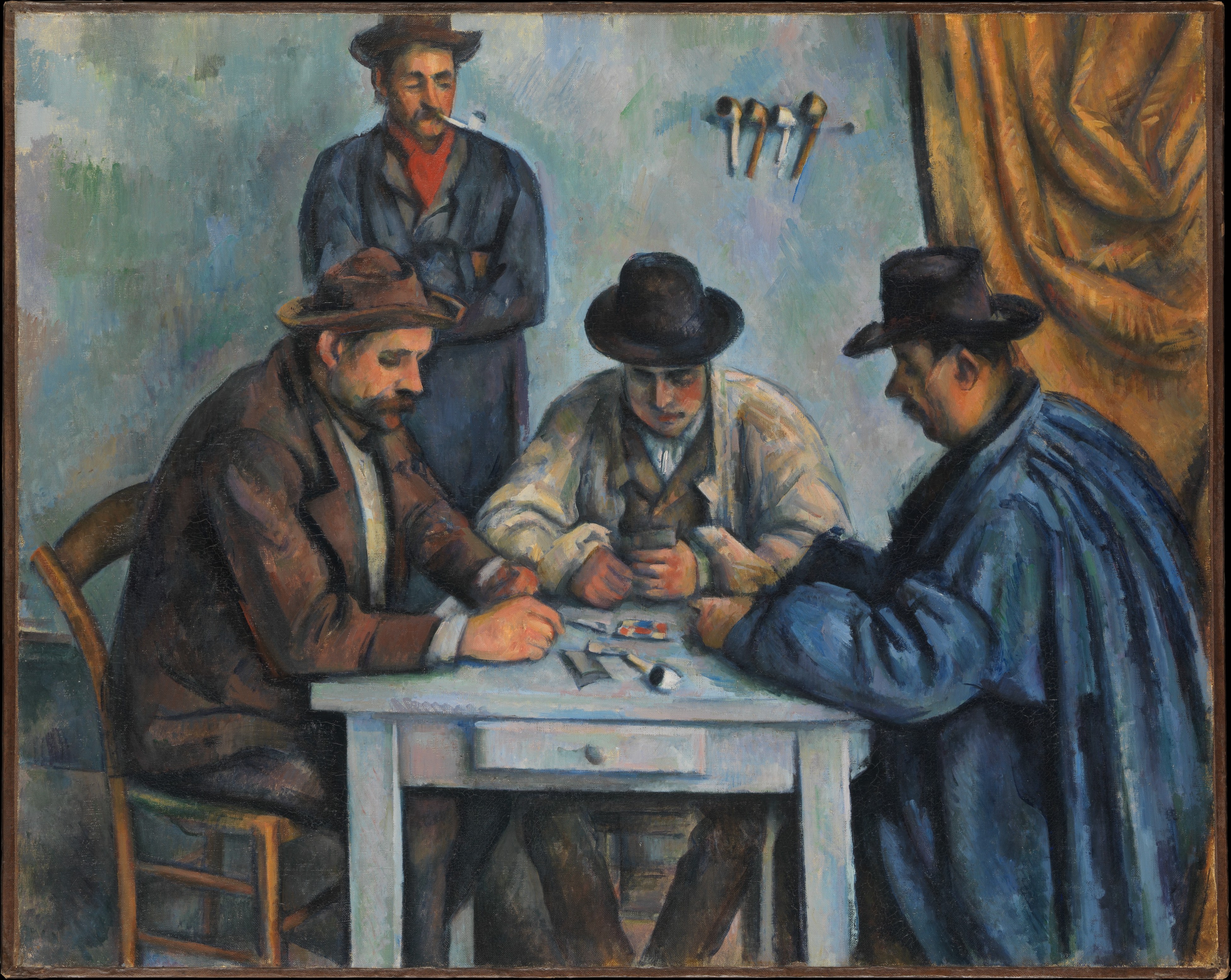
Cézanne was in his fifties when he began this campaign. The Met records that he built the scene from studies of local Provençal farmhands, reworking their poses until the group achieved its grave stability. Instead of treating rural life as anecdote, he gave ordinary workers the physical authority of figures on an ancient frieze.
A familiar subject, rebuilt
Card players had long appeared in European art, often surrounded by drink, cheating, and theatrical expression. Cézanne removes the commotion. The table forms a pale horizontal anchor; bent arms create a compact rhythm; dark hats lock the heads into a shallow arc. Four pipes on the wall quietly repeat the clustered human forms below.
Look at the player in blue. His coat is not smoothly modeled. Short strokes of cobalt, slate, turquoise, and black make the fabric advance and recede at once. The standing man’s vertical body steadies the left half, while the ocher curtain pulls down the right edge like a stage boundary. The composition feels settled, but its parts keep shifting under the eye.
Brushwork under pressure
The Met’s technical commentary notes that x-radiography revealed repeated changes to the figures, table, and chairs. This matters: the calm we see was achieved through revision, not instantaneous certainty. Active brushwork and firm structure coexist. Cézanne lets color build volume while contours tighten the bodies into monumental shapes.
That tension helps explain his continuing relevance. MoMA’s guide to Cézanne’s mark-making shows how closely he attended to pigment, paper, and the physical behavior of materials. For today’s painters—and for collectors learning to judge craftsmanship—the lesson is practical: visible handling can be disciplined rather than unfinished.
Past and Present: five answers to one problem
The Courtauld notes that Cézanne completed five Card Players paintings during the 1890s. Its two-man version strips the scene to a face-to-face ritual, while the Barnes Foundation preserves the much larger, more populated variant that followed the Met picture. These are not duplicates. They record a sustained investigation into scale, grouping, and psychological distance.
This serial thinking connects CanvasNoble’s Past and Present philosophy. The past survives not as a fixed recipe but as a problem each generation can reopen. Compare the controlled line in Botticelli’s Birth of Venus or the measured scale of Fan Kuan’s Travelers Among Mountains and Streams: in each, technique organizes how slowly we look.
A hand-painted reproduction also raises a useful distinction. Fidelity is more than matching objects or colors; it requires understanding how strokes create structure, as explained in our guide to hand-painted reproductions versus canvas prints. A smoother surface might resemble the scene yet lose Cézanne’s method.
Look again
Which element first makes this gathering feel still—the table, the hats, or the lowered eyes? Then notice how the brushwork refuses to be still at all.


Comments