
Henri Matisse’s Woman with a Hat: When Color Stopped Describing

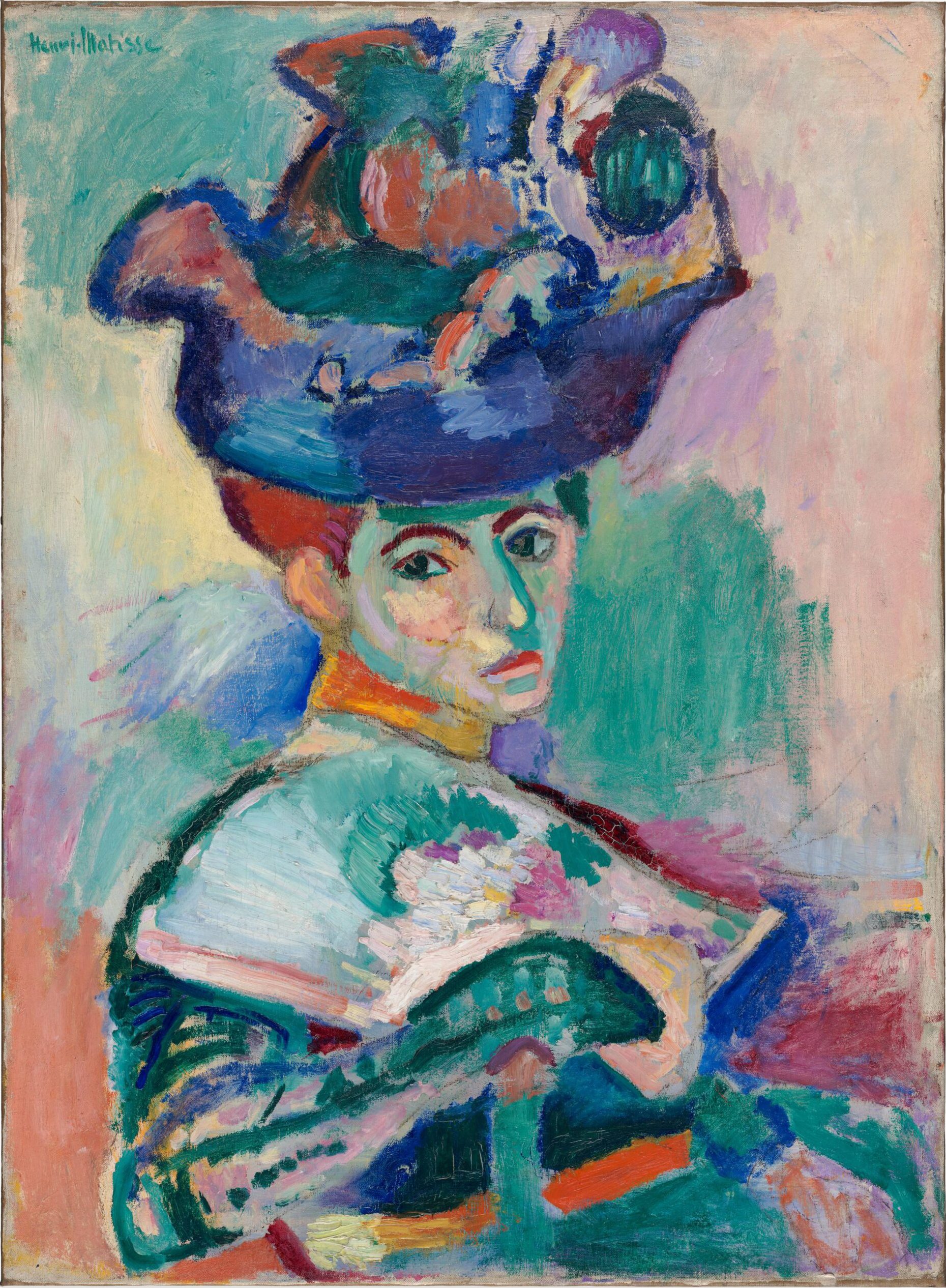
Henri Matisse’s Femme au chapeau (Woman with a Hat), painted in 1905, is an oil-on-canvas portrait of his wife, Amélie. Measuring 80.8 by 59.7 centimeters and now in the San Francisco Museum of Modern Art, it looks less like a record of fashionable appearance than a declaration that color can think for itself.
A portrait that broke the rules
Matisse submitted the painting to the 1905 Salon d’Automne in Paris despite warnings that its unfinished-looking surface and improbable colors might embarrass him. The reaction was fierce. Critic Louis Vauxcelles grouped Matisse and nearby painters under the label les fauves—“wild beasts”—a name that became Fauvism. SFMOMA’s account makes clear that the scandal was not simply brightness: placing non-natural color across a familiar human face challenged what a portrait was expected to describe.
Amélie sits turned slightly away while meeting the viewer with one steady eye. Her extravagant hat spreads across the canvas like a second painting, assembled from green, violet, blue, rust, and white. A green stroke runs down her nose; turquoise, pink, yellow, and lilac divide her face. Glove, fan, dress, chair, and background nearly dissolve into one restless field. Yet the portrait remains legible because Matisse organizes contrasts rather than modeling every volume smoothly.
When color becomes structure
SFMOMA’s recent research notes broad passages of paint, sketchy handling, and places where bare canvas and pencil underdrawing remain visible. Those gaps are not evidence that the work lacks control. They let the eye complete the image while preserving the speed of its making. The Metropolitan Museum of Art describes Fauvist space as shaped by moving color planes instead of traditional depth; that principle is easy to test here. Cover the sitter’s features mentally, and the picture still balances through the dark hat brim, cool green center, coral edges, and blue-violet diagonals.
The National Gallery of Art traces Matisse’s development through Cézanne, Gauguin, and other predecessors, but Woman with a Hat makes inheritance feel newly unstable. Unlike Cézanne’s weighty structure, discussed in CanvasNoble’s Card Players article, Matisse allows a face to be both likeness and color field. This is an interpretation, but the technique supports it: identity survives even as local color disappears.
Past and Present: learning from a “wrong” color
For CanvasNoble’s Past, the original belongs to a specific 1905 moment, collection history, material surface, and authorship. It should not be confused with any later version. For the Present, its lesson remains practical: living artists can use color relationally—asking what a green makes the adjacent pink do—rather than treating pigment as a label for objects. Collectors can make the same comparison, judging whether a work’s palette creates structure or merely decoration.
A hand-painted reproduction presents an exacting craftsmanship problem. Matching isolated swatches is not enough; the painter must preserve the pressure, spacing, visible ground, and color relationships that keep the sitter coherent. CanvasNoble’s guide to reproductions and its Present collection clarify why a newly made interpretation is a contemporary object, not a Matisse original.
Look again at the green running from forehead to chin. Does it read first as shadow, outline, or pure color—and how does your answer change when you step back?


Comments