
Édouard Manet’s Olympia: The Gaze That Made Modern Painting Uncomfortable

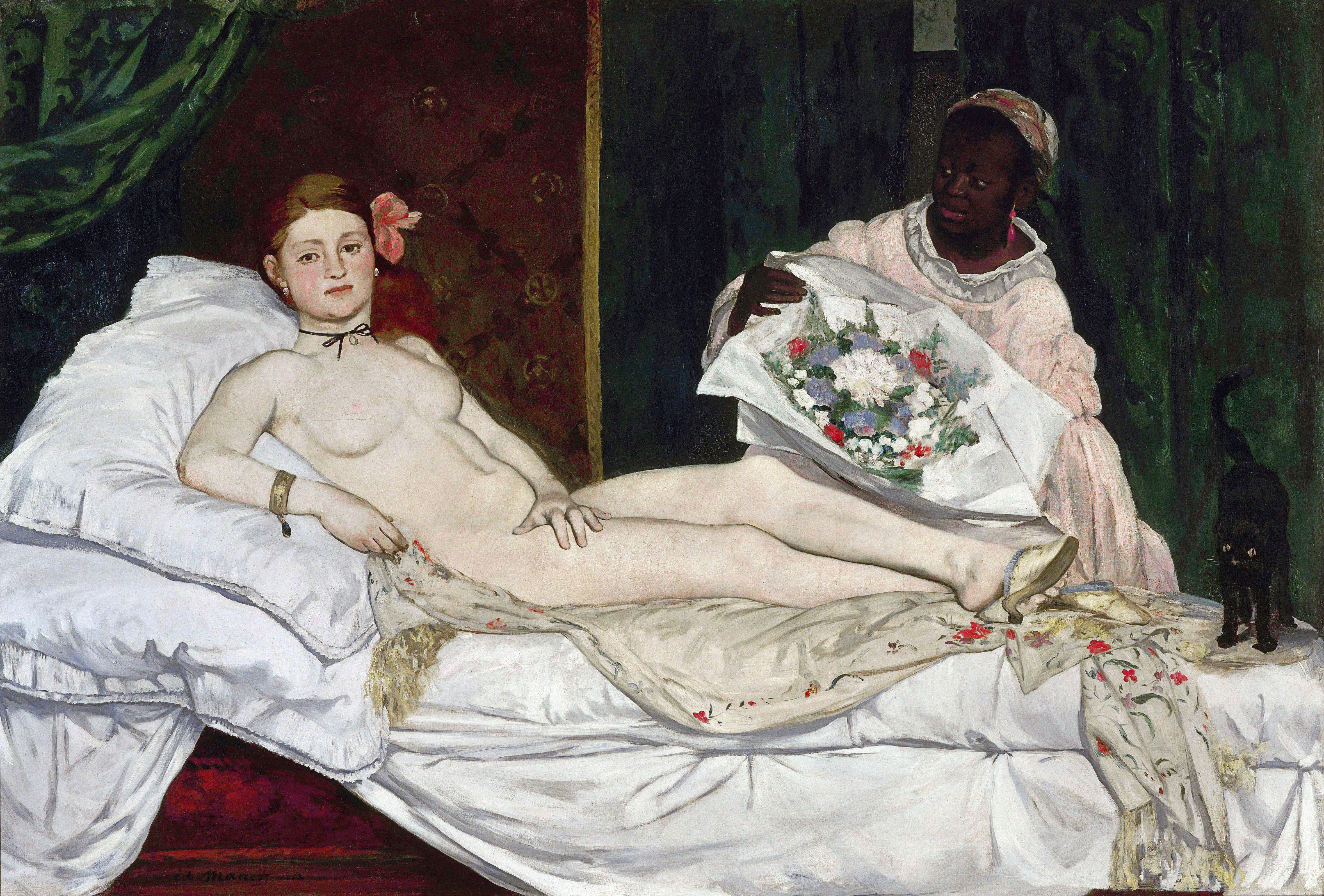
At the 1865 Paris Salon, Édouard Manet’s Olympia met viewers with an unnerving calm. Painted in 1863 in oil on canvas and now in the Musée d’Orsay, the work borrows the familiar pose of the reclining nude, then strips away mythology’s protective veil. The setting is modern, the woman’s attention is alert, and her gaze reaches beyond the picture. That directness—not nudity alone—made the painting feel like a challenge.

Édouard Manet, Olympia, 1863, oil on canvas, Musée d’Orsay, Paris. Google Art Project reproduction via
; Public Domain Mark 1.0.
A familiar pose made newly confrontational
Manet clearly looked to Titian’s Venus of Urbino, but transformed its visual grammar. Olympia’s body is sharply lit against the bed and dark background; a black cat arches at her feet while a maid arrives with flowers. The Metropolitan Museum of Art explains that Salon audiences read the figure as a contemporary sex worker rather than a distant goddess. The painting therefore collapsed the comfortable distance between art, money, desire, and modern Paris.
The Musée d’Orsay’s comparison with Alexandre Cabanel’s Birth of Venus is especially revealing. Cabanel’s idealized goddess was celebrated in 1863; Olympia, shown two years later, stares back with what the museum calls “calm assurance.” Her hand is not passive decoration: it closes the composition and asserts control over access to her body. Even the bouquet, likely sent by an unseen admirer, becomes part of the social transaction.
How the painting refuses polish
Manet’s technique intensifies that confrontation. Broad zones of ivory, cream, green, brown, and black sit beside one another with abrupt transitions. Dark outlines refuse the soft modeling prized by academic painters, and the shallow space makes the room feel staged rather than illusionistic. A close reading from Smarthistory shows how these formal choices redirect attention from ideal beauty to the act of looking itself. The handling is economical, but every contrast carries pressure.
Past and Present: who controls the gaze?
For Canvas Noble’s Past and Present lens, Olympia offers more than a story of scandal. In the past, it exposed the double standard that accepted the nude when disguised as antiquity but resisted a modern woman who acknowledged her viewer. In the present, it asks who is granted agency inside an image—and whose labor or identity remains peripheral. The maid’s presence invites today’s viewers to consider race and service alongside gender and commerce; that is an interpretation, but one grounded in what the composition visibly assigns to center and edge.
This makes Olympia a useful companion to Canvas Noble’s essays on Botticelli’s Birth of Venus and John Singer Sargent’s Madame X: all three paintings show how pose, finish, and public expectations shape meaning. For living painters, the lesson is precise: a gaze can organize an entire picture. For collectors considering a hand-painted reproduction, accurate labeling “after Manet” matters, and skilled craft should preserve the original’s tonal flatness rather than smoothing it into academic polish. Canvas Noble’s reproduction guide explains why material process and disclosure matter.
Look again
Look again: when Olympia meets your eyes, who controls the encounter—the viewer, the subject, or the painting itself?


Comments