
Jan van Eyck’s The Arnolfini Portrait: A Mirror That Changes the Room

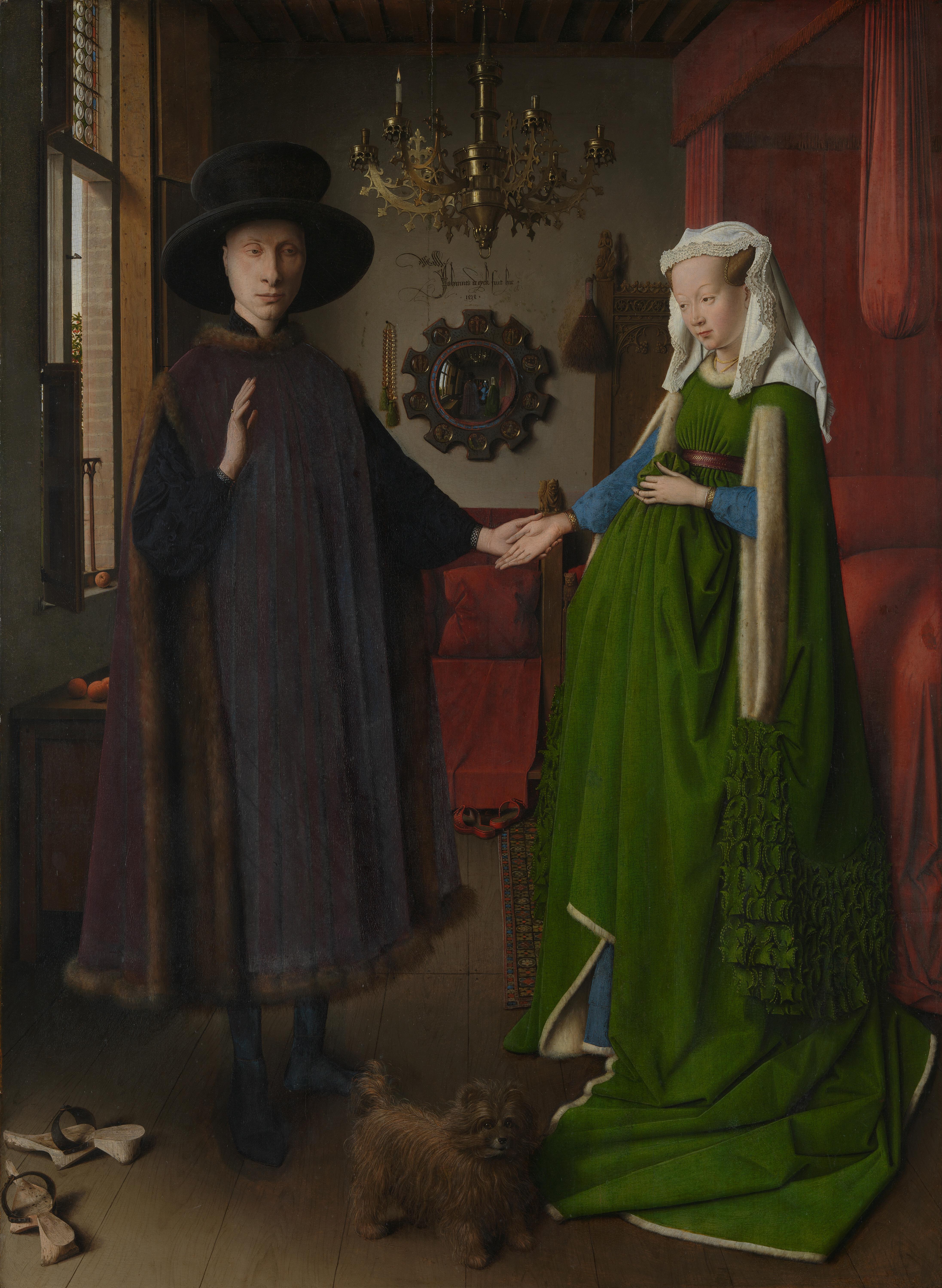
In a quiet fifteenth-century room, two richly dressed figures stand among a dog, discarded shoes, fruit, a brass chandelier, and a convex mirror no larger than a hand. Jan van Eyck’s The Arnolfini Portrait (1434), painted in oil on oak panel and now at the National Gallery, London, makes the ordinary look almost impossibly exact. Yet its precision does not settle what the scene means; it makes the questions sharper.

Jan van Eyck, The Arnolfini Portrait, 1434, oil on oak panel, National Gallery, London. Image source: National Gallery reproduction via Wikimedia Commons; Public Domain Mark 1.0.
A room built from light
Van Eyck did not invent oil paint, but he demonstrated how far it could be pushed. Thin layers and minute touches separate fur from wool, polished wood from glass, and daylight from reflected gleam. The National Gallery notes that he sometimes bounced the brush for tiny color accents, scratched bristles into wet paint, and even left a thumbprint near the dog. Such evidence turns virtuosity into craftsmanship we can imagine: looking, adjusting, and handling paint at intimate scale.
The convex mirror is the painting’s hinge. It reflects the couple from behind and adds two more figures at the doorway, extending the room into the viewer’s space. Around it, miniature scenes from Christ’s Passion compress another narrative into the wall. The inscription above—“Jan van Eyck was here, 1434”—sounds less like a conventional signature than a statement of presence. Explore the painting at high resolution to compare the mirror, beads, dog, and scratched highlights.
Evidence, debate, and attribution
The work was long described as a marriage scene, but that interpretation is not secure. The National Gallery’s scholarly catalogue advises treating it as a double portrait and identifies the sitters only cautiously. The woman’s lifted dress, for example, should not be taken as proof of pregnancy; fashionable fabric and pose can create the silhouette. This is a valuable collecting lesson: familiar labels are not the same as verified facts.
Technical study complicates the symbolic readings further. Infrared reflectography revealed changes to faces, hands, feet, and furnishings; some architectural details once treated as central symbols were added without underdrawing. Meaning may remain open, while material evidence records the sequence of making. That balance—interpretation beside examination—also drives modern attribution work, as seen in CanvasNoble’s article on Judith Leyster’s Self-Portrait.
Past and Present: the discipline of detail
For living artists, the painting offers more than a catalogue of symbols. It shows how texture, scale, and reflected space can turn a domestic interior into a psychological stage. Compare its compressed room with Bosch’s crowded imaginary world: both reward slow looking, but one builds wonder through tangible surfaces while the other multiplies invention.
For collectors, the lesson is to separate image, object, and claim. A digital reproduction can reveal the mirror, beads, and brush marks at extraordinary magnification, yet it cannot reproduce the oak support, layered paint, age, or documented provenance of the original. CanvasNoble’s guide to hand-painted reproductions and canvas prints explains why those distinctions matter. A skilled hand-painted interpretation should be described as a new reproduction, never confused with Van Eyck’s historic object.
Look again at the mirror: do you first notice what it reflects, how it bends space, or how its tiny frame changes the authority of the entire room? That question is Van Eyck’s enduring gift. The past survives not as a closed answer, but as evidence that present-day viewers can test.


Comments