
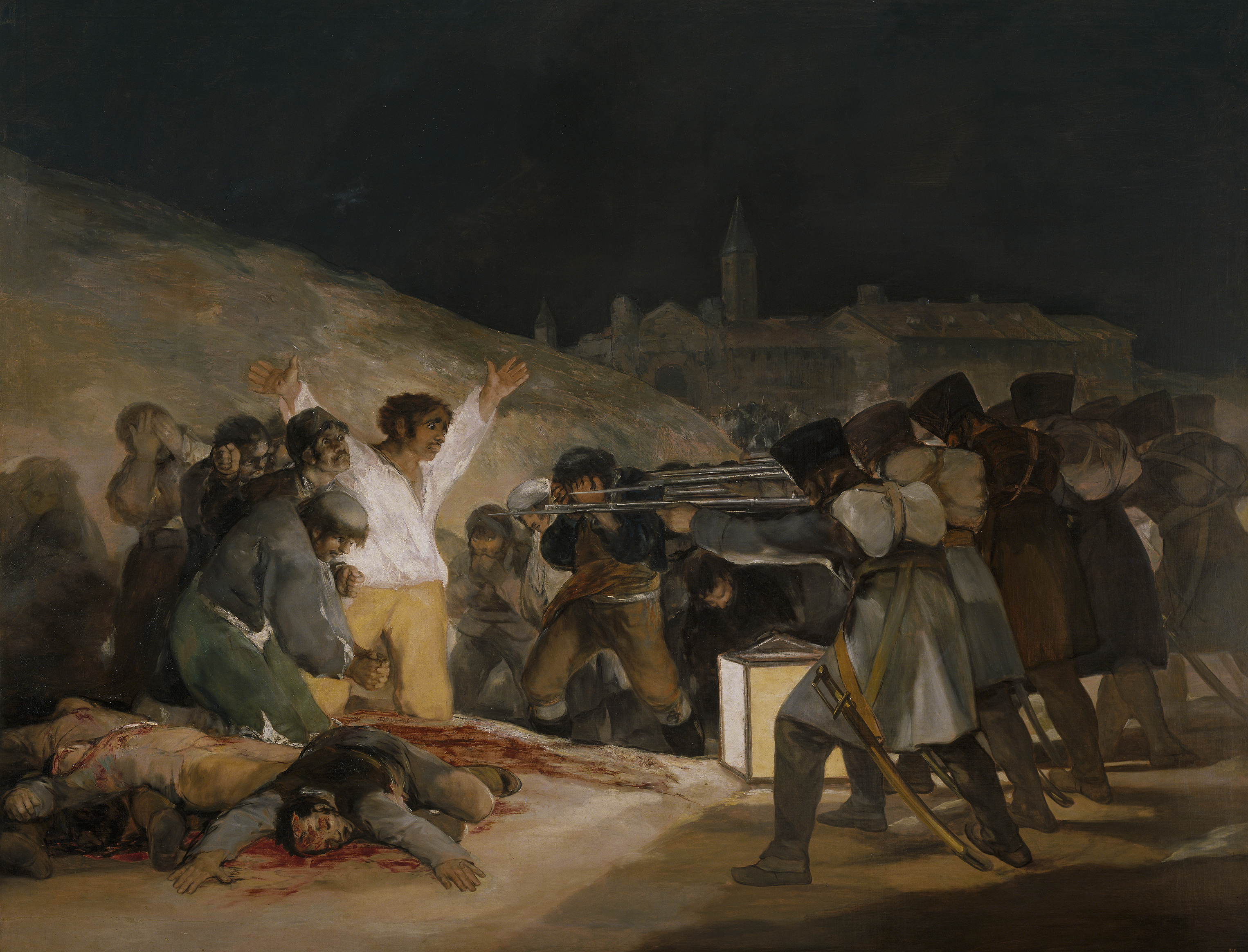
Francisco Goya’s The Third of May 1808: Light Against Violence

Francisco Goya’s The Third of May 1808 in Madrid, painted in 1814 in oil on canvas, turns a specific reprisal into one of art’s clearest arguments against mechanized violence. Now in Madrid’s Museo Nacional del Prado, the vast canvas—about 2.68 by 3.47 meters—does not offer a victory scene. It asks what history painting can do when heroism has failed.

A remembered night, painted later
The work looks back to French troops’ executions of Madrid civilians after the uprising of May 2, 1808. Goya did not paint it as an on-the-spot report: he created the canvas six years later, after Napoleon’s forces had left Spain. That distance matters. Rather than reconstructing every coordinate, he organizes memory into a moral encounter: a firing squad on the right, victims on the left, and a box lantern between them.
Light as evidence
At the center, a man in white and yellow throws open his arms. Light strikes his shirt, face, and spread hands while the soldiers’ faces disappear. The pose invites comparison with crucifixion imagery, but Goya refuses clean martyrdom: blood darkens the earth, bodies press into the foreground, and the next captive covers his face.
The Fundación Goya catalogue emphasizes how the anonymous soldiers operate as an impersonal mechanism while the condemned register distinct responses—fear, rage, prayer, disbelief. The lantern is not comforting. It exposes rather than rescues. Goya’s warm light and acid yellow pull the eye forward; repeated rifles, backpacks, and bent bodies lock the executioners into a single diagonal. Loose, urgent brushwork keeps the victims physically unstable.
The result is composition doing ethical work: pattern becomes coercion, while variety becomes humanity.
Past and present: history painting without triumph
Traditional history painting often elevated exemplary heroes. Goya instead centers civilians at the instant power acts upon them. Smarthistory’s analysis places that reversal within the Napoleonic occupation. Goya’s related Disasters of War prints—including The Met’s impression of And there is nothing to be done—widen the question from national memory to the repeated suffering war produces.
For today’s painters and viewers, the lesson is not to imitate Goya’s horror but to notice his choices. He withholds the soldiers’ identities, gives the victims psychological range, and makes illumination morally ambiguous. Compare that construction with the poised civic virtue of Jacques-Louis David’s Death of Socrates or the concentrated physical force of Artemisia Gentileschi’s Judith Beheading Holofernes: each uses bodies, light, and spacing to direct judgment, but toward very different kinds of action.
A collector’s looking lesson
For collectors, the painting is also a reminder that subject alone does not create meaning. Scale, edge, rhythm, and tonal contrast determine how an image behaves in a room. A hand-painted reproduction can study those relationships, but it should remain clearly identified as a newly made interpretation—not confused with Goya’s original or its history.
Look again at the square lantern. Does it illuminate truth, assist the executioners, or do both at once? That unresolved question is why The Third of May 1808 remains present: Goya makes looking feel like a responsibility.


Comments