
Rosa Bonheur’s The Horse Fair: Motion, Ambition, Past and Present

At more than sixteen feet wide, Rosa Bonheur’s The Horse Fair feels less like a quiet gallery picture than a weather system of muscle, dust, and noise. Painted in oil on canvas from 1852 to 1855 and now in the Metropolitan Museum of Art, it transforms the horse market on Paris’s Boulevard de l’Hôpital into monumental drama. Bonheur’s realism is exacting, but never merely descriptive: every bridle, flashing flank, and lifted hoof contributes to a controlled surge across the canvas.
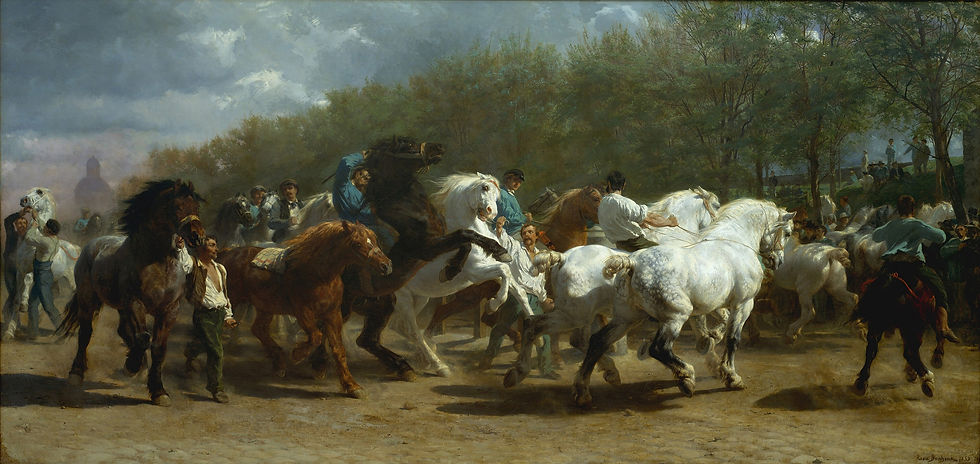
Rosa Bonheur, The Horse Fair, 1852–55, oil on canvas, The Metropolitan Museum of Art. Image: The Met; public domain/CC0 via
.
A Market Turned into an Epic
The composition runs in a broad arc from left to right. Dark horses anchor the center while luminous Percherons catch the light, their rounded bodies set against broken clouds and deep foliage. The diagonal avenue of trees pulls the eye toward the distant dome of the Salpêtrière, creating depth without weakening the foreground. Bonheur varies her touch to suit each surface—fine marks for glossy coats, broader strokes for dust and sky—so texture becomes storytelling.
This authority came from sustained observation. The Met records that Bonheur sketched at the market twice a week for a year and a half. The National Gallery’s detailed account explains how handlers drove horses into forceful movement so buyers could judge their strength and mobility. Bonheur compressed those repeated studies into one continuous rhythm. The scene looks spontaneous because its structure is carefully prepared.
The Past: Realism, Scale, and Artistic Agency
When the painting appeared at the 1853 Paris Salon, Bonheur was already respected as an animal painter, yet this work made her internationally famous. Her ambition mattered in a culture that often restricted women’s access to training and public working spaces. The National Gallery’s introduction to Bonheur notes her anatomical study and the police permission she obtained to wear trousers while working in the male-dominated market.
Bonheur also looked backward. She called the painting her “Parthenon frieze” and drew on ancient sculpture and equestrian art by Théodore Géricault and others. Yet she did not imitate those models. She replaced ceremonial procession with modern commerce and made working animals—not generals or mythic heroes—the source of grandeur. The picture belongs to the Past while resisting a fixed, nostalgic reading.
The Present: What Close Looking Still Teaches
For living artists, The Horse Fair shows how observation becomes invention: study anatomy, repeat a motif, then organize it for emotional force. For collectors, it demonstrates why condition and surface matter. National Gallery conservation research on its smaller autograph version found fine brushwork in the horses, vigorous strokes in the sky, and broad handling in the ground—differences that discolored varnish had partly concealed.
CanvasNoble’s Past and Present idea comes alive in that contrast. Historical mastery is not a recipe, but a set of choices worth examining. Compare Bonheur’s pattern and intimacy with Mary Cassatt’s The Child’s Bath, her choreography of labor with Bruegel’s The Harvesters, or her treatment of motion and preservation with Rembrandt’s The Night Watch.
A hand-painted reproduction, where undertaken, is a newly made interpretation, never the original. Its educational value lies in testing proportion, rhythm, and brushwork by hand. Look again at Bonheur’s central rearing horse: does your eye follow the animal’s anatomy first, or the circular movement connecting horse, rider, and crowd?


Comments