
Georges Seurat’s La Grande Jatte: Dots, Distance, Past and Present

From across a gallery, Georges Seurat’s A Sunday on La Grande Jatte—1884 looks serenely continuous: a riverside crowd, clipped lawns, parasols, boats, and summer light. Move closer and that calm surface breaks into thousands of distinct touches. Painted from 1884 to 1886 in oil on canvas and now in the Art Institute of Chicago, the monumental work turns an ordinary leisure scene into an experiment in color, rhythm, and looking. Through CanvasNoble’s Past and Present lens, it is both a historic masterpiece and a living lesson in how images are constructed.
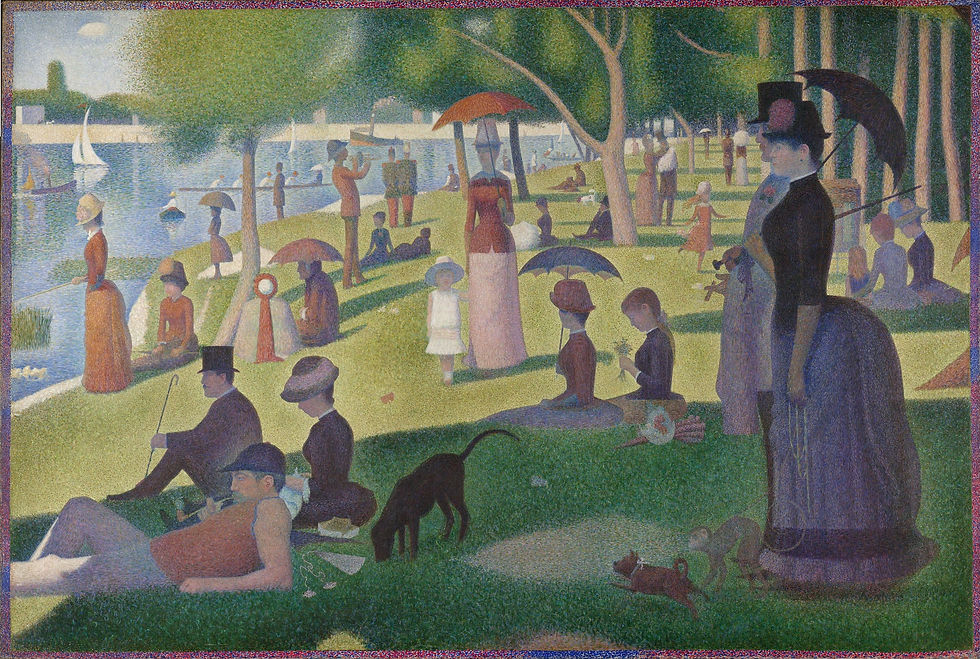
Georges Seurat, A Sunday on La Grande Jatte—1884, 1884–86, oil on canvas, Art Institute of Chicago, Helen Birch Bartlett Memorial Collection. Image: Art Institute of Chicago via Wikimedia Commons; public domain.
A Modern Sunday, Built Slowly
La Grande Jatte was an island in the Seine northwest of central Paris, popular with urban visitors on Sundays. Seurat arranged its walkers, soldiers, children, pets, and reclining figures as a measured procession rather than a spontaneous snapshot. Profiles repeat; vertical trees answer upright bodies; water and sunlit grass form broad horizontal bands. The Art Institute’s account of the painting’s making shows how deliberately Seurat developed this order through studies over roughly two years.
That preparation separated him from the speed associated with Impressionist painting. The Metropolitan Museum of Art’s final study preserves looser, crossed strokes and a livelier surface. In the finished canvas, the marks tighten and the figures become stable, almost sculptural. When the work appeared at the eighth Impressionist exhibition in 1886, its modern subject belonged to the group’s world, but its method announced a new direction.
Divisionism: Color Mixed by the Viewer
Seurat preferred the term Divisionism: instead of mixing every hue on the palette, he placed touches of related or complementary color beside one another so the viewer’s eye could combine them at a distance. Red intensifies beside green; yellow vibrates against violet or blue. The effect is not literally a digital screen, yet the comparison is useful: both depend on small units becoming a larger image through perception.
The painting also makes distance part of its design. From afar, light and form cohere; close up, the labor becomes visible. Seurat later added a painted border whose colored marks mediate between the scene and its white frame. The Metropolitan Museum’s history of Impressionism places this technique within the movement’s fractured final exhibition, when artists increasingly pursued individual systems.
A Social Scene Without a Single Answer
The scene is socially crowded but emotionally reserved. People occupy the same park without much contact; most gaze forward, sideways, or away. This stillness has invited competing readings—modern harmony, satire, alienation, even theatrical posing. The painting does not settle the issue. Its power comes partly from making social life look both public and private.
Past, Present, and the Work of Looking
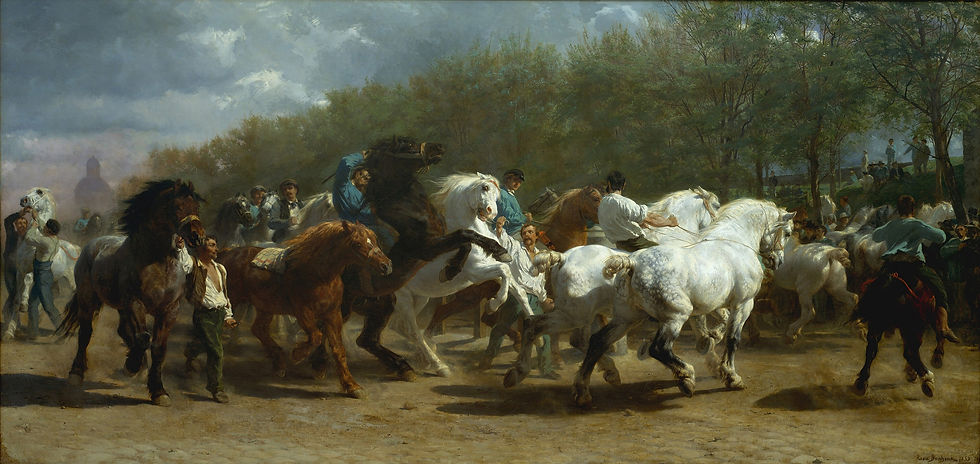
For today’s painters and collectors, La Grande Jatte offers a practical exercise. Compare its controlled color relationships with Monet’s responsive brushwork, Ogata Kōrin’s pattern-driven rhythm, or Rosa Bonheur’s orchestration of a monumental crowd. Each artist builds unity differently. Seurat reminds a hand-painted reproduction artist that accuracy is not only matching outlines: mark size, edge rhythm, color adjacency, and viewing distance all shape the result. He also reminds collectors to examine a painting twice—once from across the room, then close enough to see its decisions.
Look again at the shaded foreground and bright middle distance: do the figures seem peacefully connected, carefully staged, or isolated together? Your answer may change with every step toward or away from the canvas. That shifting experience is where Seurat’s nineteenth-century experiment remains vividly present.

Comments