
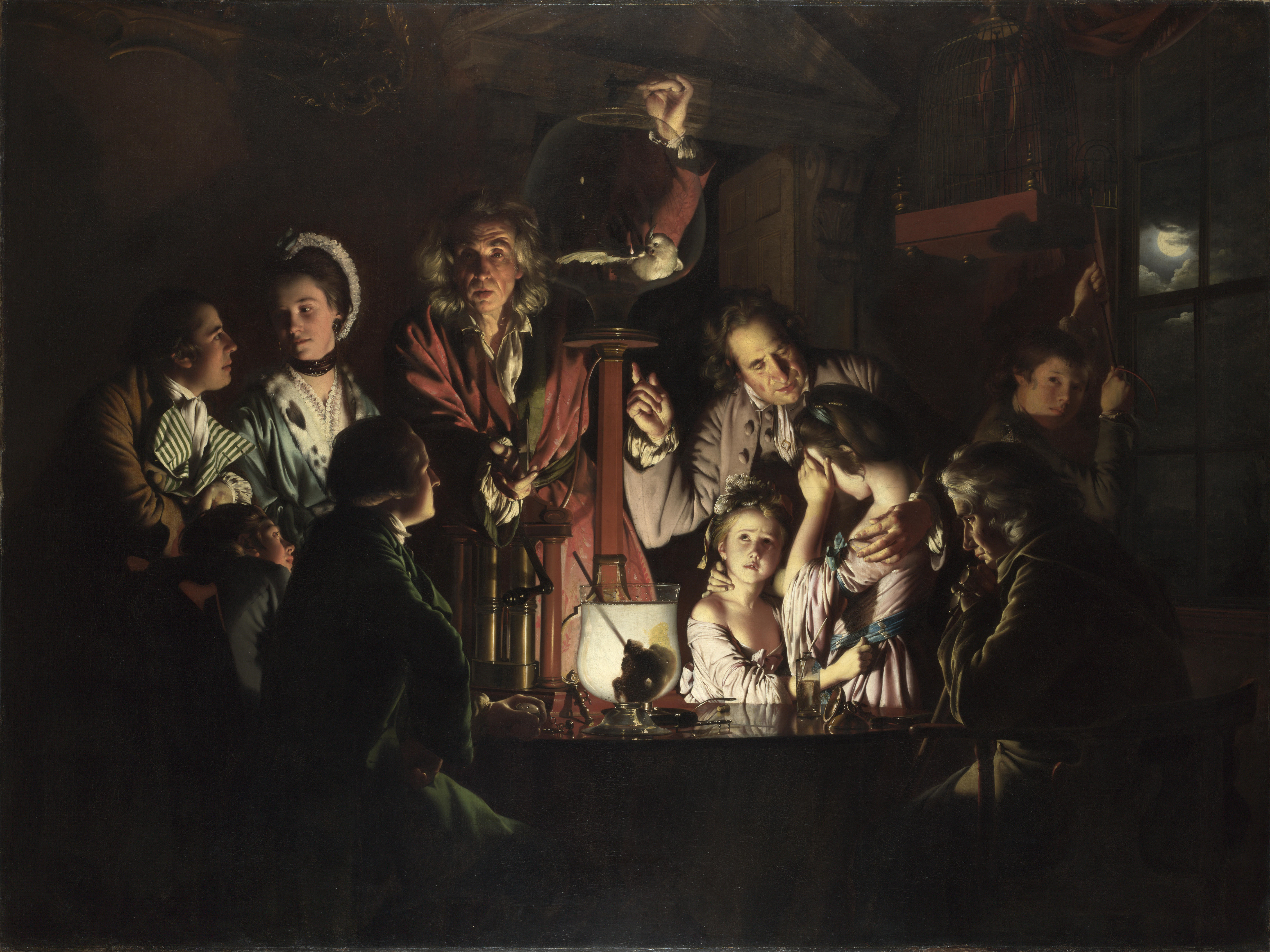
Joseph Wright’s An Experiment on a Bird in the Air Pump: Science and Suspense

In a darkened room, a white cockatoo flutters inside a glass receiver while a lecturer reaches toward the valve that controls its air. Painted in 1768, Joseph Wright of Derby’s An Experiment on a Bird in the Air Pump is an oil-on-canvas drama now in the National Gallery, London. Its scale—183 by 244 centimeters—belongs to ambitious history painting, yet its subject is contemporary science, staged before an ordinary household. That mismatch is the painting’s first revolution: modern knowledge becomes worthy of monumental art.

Modern knowledge, human reactions
The air pump itself was already more than a century old. As the National Gallery’s scholarly catalogue explains, traveling lecturers used such apparatus to demonstrate air pressure and the lethal effects of a vacuum. Wright, however, does not illustrate a textbook. He arranges an audience: two girls recoil, a boy leans forward, a man times the experiment, an older viewer thinks, and a young couple seems absorbed in each other. The lecturer faces us, almost recruiting the viewer into the test.
No outcome is shown. A boy at the right holds the bird’s cage, but we cannot tell whether he is lowering it for safety or raising it after release. The suspended ending turns curiosity into an ethical question. Are we admiring discovery, witnessing cruelty, or doing both?
Light is both subject and method
Wright built his scene around a hidden light source behind a glass vessel on the table. Faces, hands, metal, liquid, and polished wood catch different degrees of glow; beyond them, forms sink into black. The National Gallery describes the color shifts with unusual precision: the lecturer’s red robe cools toward magenta as it leaves the light, while the girls’ pale dresses deepen toward purple and darkness.
This tenebrist lighting is not merely theatrical. It behaves like the experiment itself, revealing some things and withholding others. Wright’s study of light and dark drew on an older European tradition, but he redirected it toward the Enlightenment world of instruments, public demonstrations, and new audiences.
Past and Present: a lesson in looking
Within CanvasNoble’s Past, the painting is a historical object: a large, authenticated work by a deceased artist, tied to the scientific and industrial culture of eighteenth-century Britain. Yet its Present is immediate. Today’s artists, photographers, and filmmakers still use a single concentrated light to control attention and emotion; museums and collectors still ask how spectacle changes our judgment.
The same distinction matters in Reproduction. A hand-painted study after Wright can explore transitions from warm highlights to near-black passages, but it remains a new interpretation, never the 1768 original. The craft lesson is concrete: do not treat shadow as empty background. Notice how Wright gives darkness structure, letting it measure distance, isolate gestures, and keep the bird’s fate unresolved.
Look again
Look again at the circle of faces. Which reaction resembles your own—and does the bright center make you more curious, or more uneasy?


Comments