
Henry Ossawa Tanner’s The Banjo Lesson: Learning, Light, and Dignity

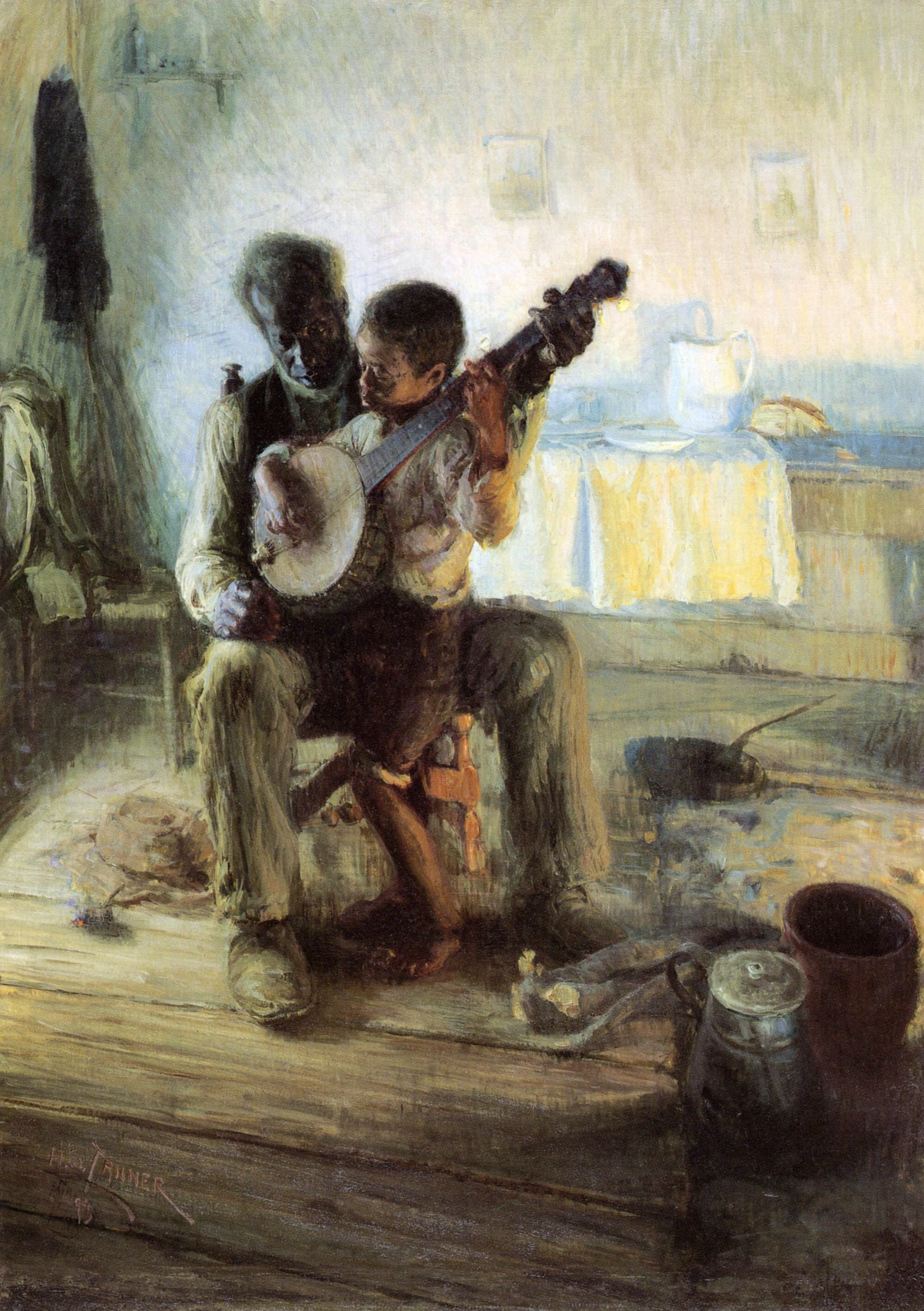
Henry Ossawa Tanner’s The Banjo Lesson (1893) is an oil-on-canvas scene of an older Black man guiding a boy’s hands across a banjo. Now in the Hampton University Museum, the painting turns a modest room into a study of knowledge passed between generations. Its power rests not in spectacle, but in attention: two bent heads, four carefully placed hands, and light that makes instruction feel almost sacred.

Henry Ossawa Tanner, The Banjo Lesson, 1893, oil on canvas, Hampton University Museum. Image source: Wikimedia Commons; public domain.
A lesson built from light
Two illuminations organize the room. A cool, bluish daylight spreads across the rear wall and the elder’s shirt, while a warm source outside the frame touches the table, floorboards, and child. Smarthistory reads that warm–cool division as generational symbolism; even without fixing a single meaning, the contrast gives the quiet scene emotional structure.
Tanner anchors the figures with a stable triangle formed by shoulders, arms, and the round body of the instrument. The banjo’s long neck creates a diagonal that keeps the composition from becoming static. Loose passages—the coat, crock, skillet, hat, and pipe—describe a working household without turning its occupants into picturesque props. The essential detail is tactile: the man supports the instrument’s weight so the child can learn by doing.
Reclaiming a familiar motif
In late-19th-century American popular culture, banjo-playing Black figures often appeared in demeaning minstrel caricature. Tanner substituted concentration, skill, and intimacy for performance. Both sitters look at the instrument, not at us; the viewer is not offered a show but allowed to witness patient teaching.
The choice was inseparable from Tanner’s own path. PAFA notes that he studied there with Thomas Eakins before leaving for Paris in 1891, where he trained at the Académie Julian and gained international recognition. The Banjo Lesson joins American Realist observation to the compositional gravity Tanner absorbed from European painting. It entered the Hampton collection in 1894, an early institutional home for a work that treated Black domestic life with dignity and complexity.
Past and Present: what the painting teaches now
Canvas Noble’s Past, Present, and Reproduction framework helps clarify why this painting still matters. In the Past, attribution, provenance, and institutional custody establish the historical object: the signed 1893 canvas belongs to Hampton University Museum. The painting’s physical surface, scale, and documented history are inseparable from the original.
In the Present, its lesson is compositional as well as cultural. Living painters can study how restricted space, opposing color temperatures, and small hand gestures carry narrative without theatrical action. Collectors can likewise ask whether a work earns attention through looking rather than explanation. The Denver Art Museum’s Tanner overview situates his career across Philadelphia and Paris, reminding us that artistic identity can be locally rooted and internationally formed.
A hand-painted reproduction, by contrast, should be described honestly as a new interpretation, never as the historic Tanner. Its value would lie in the craft of translating the picture’s cool wall, warm hearth light, restrained palette, and carefully balanced hands. The challenge is not to copy an outline; it is to understand how light, touch, and spacing create respect.
Look again at the four hands around the banjo: which one appears to lead, and which one makes learning possible?


Comments