
Grant Wood’s American Gothic: Pattern, Parody, and Precision

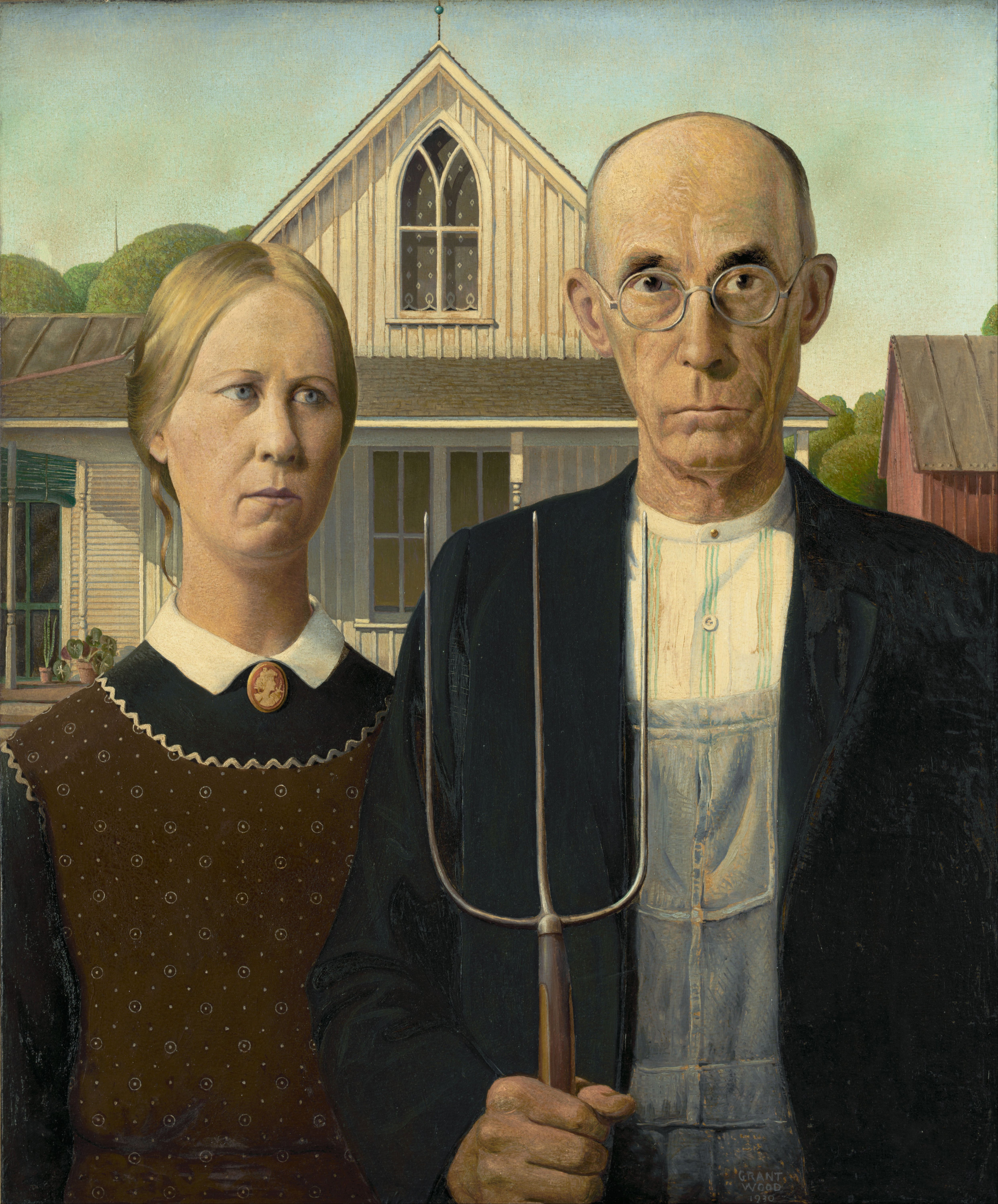
Few images have been borrowed, parodied, or argued over as often as American Gothic. Grant Wood painted it in 1930 in oil on Beaver Board; the original, measuring 78 by 65.3 centimeters, belongs to the Art Institute of Chicago. Its severe pair and pointed farmhouse window look instantly familiar, yet the painting’s authority comes less from its subject than from Wood’s exact control of pattern, posture, and tone.

A Real House, Invented Residents
Wood noticed the Carpenter Gothic house in Eldon, Iowa, and sketched it before inventing the people who might live there. The Smithsonian American Art Museum preserves a related house study that reveals how deliberately he moved from observation to design. His models were his sister, Nan Wood Graham, and his dentist, Dr. Byron McKeeby, painted separately rather than as an actual household. They represent a farmer and his adult daughter—not husband and wife, as the Art Institute’s frequently asked questions explain.
That distinction shifts the story. Instead of recording one family, Wood assembled an emblem from real people, a real building, and carefully chosen clothing. The woman’s cameo, apron, and printed dress suggest an earlier generation; the man’s overalls, dark jacket, and pitchfork make labor visible without showing work in progress. Their expressions remain guarded enough to support admiration, unease, or satire.
How Pattern Turns Portrait into Symbol
Wood locks those details together through repetition. The pitchfork’s three tines echo the seams of the farmer’s overalls; vertical stripes answer the house siding; the sharp window arch rises behind the two heads. Even the woman’s dress pattern rhymes with the curtain above her shoulder. This visual architecture makes the figures feel inseparable from the house. His smooth, sharply described surfaces also recall Northern Renaissance painting, which Wood studied during European travel.
Past and Present: An Image That Keeps Changing
Painted as the Great Depression began, American Gothic became associated with Regionalism and debates about rural American character. Some early viewers saw an insult; Wood insisted on a more affirmative reading. The tension was never fully resolved, which is one reason the image endures. The Art Institute’s collection record and curatorial account let us separate the painting’s documented history from later assumptions.
For Canvas Noble’s Past and Present lens, the work offers a practical lesson. The Past includes the securely attributed original and its evidence; the Present includes living artists who recode familiar poses to question identity, labor, and belonging. Reproduction adds another layer: the painting is public domain in the United States, as the Art Institute’s library documents, but a hand-painted interpretation still differs from both Wood’s original surface and a printed copy.
A Collecting and Reproduction Lesson
Collectors and painters can learn from that difference. A convincing interpretation needs more than the pitchfork and famous faces: it must preserve the cool daylight, compressed spacing, fine-edged patterns, and subtle balance between flesh, fabric, and architecture. Compare those relationships with Canvas Noble’s Past collection, Present collection, and hand-painted reproductions philosophy. Then look again: if the pitchfork disappeared, would the painting still feel as disciplined—or as unmistakably American?


Comments