
Caspar David Friedrich’s Wanderer Above the Sea of Fog: Looking, Distance, Past and Present

Caspar David Friedrich’s Wanderer above the Sea of Fog places us behind a solitary man at the edge of a precipice. Painted around 1817–18 in oil on canvas, the 94.8-by-74.8-centimeter work belongs to the Hamburger Kunsthalle. The figure’s dark coat and upright walking stick are crisp against rolling white vapor; distant peaks appear, disappear, and return like thoughts. Rather than offering an unobstructed panorama, Friedrich makes another act of looking the first thing we see.
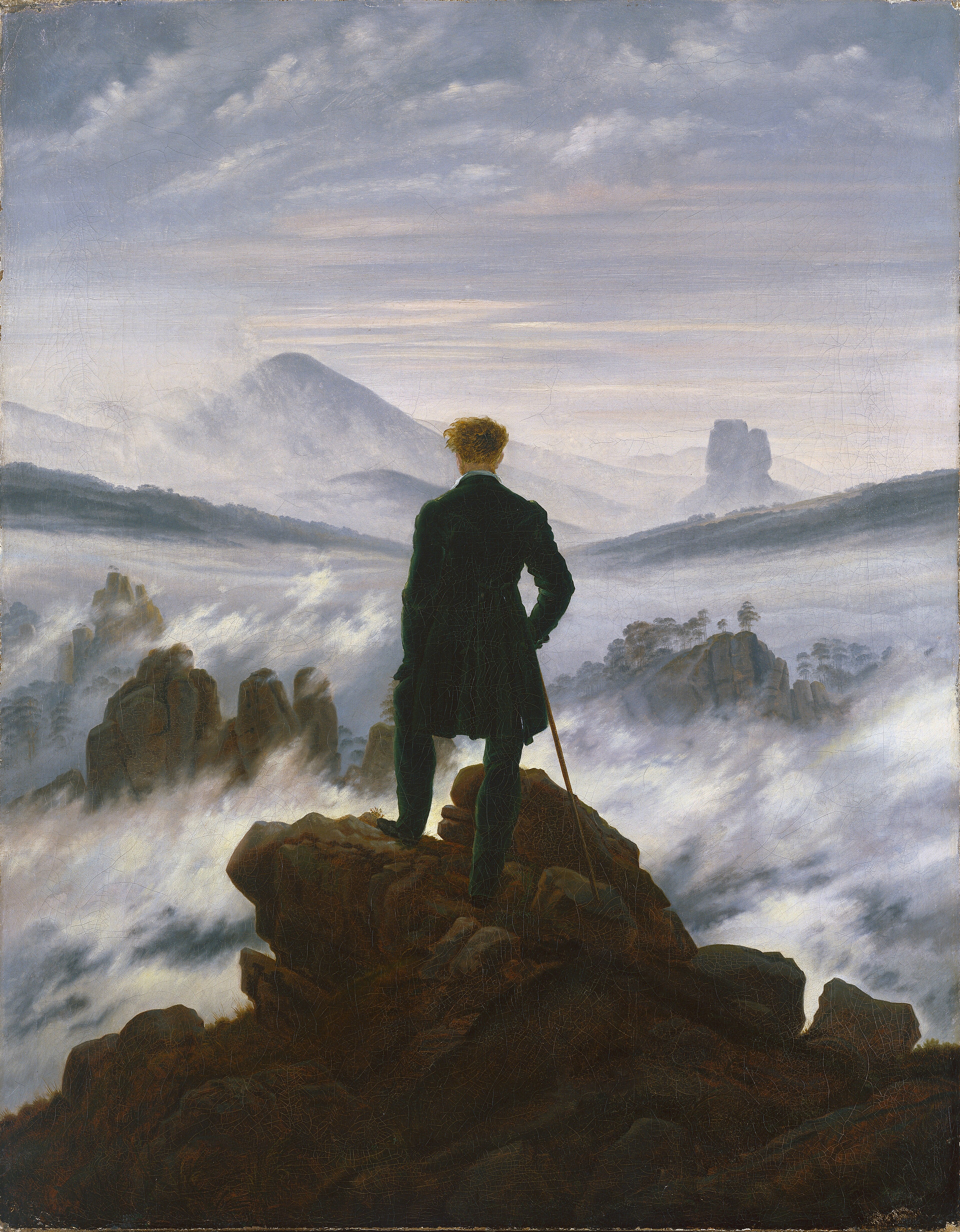
Caspar David Friedrich, Wanderer above the Sea of Fog, c. 1817–18, oil on canvas, Hamburger Kunsthalle. Image: Wikimedia Commons, Public Domain Mark 1.0.
A landscape assembled to feel whole
Friedrich built the scene from observed parts instead of copying one uninterrupted view. Hamburger Kunsthalle research connects the foreground rock to a drawing made at the Kaiserkrone in Saxon Switzerland in 1813, the conical mountain at left to an earlier study of the Rosenberg, and the left middle-ground formation to the Gamrig. He adjusted and combined them into a vertical composition whose mountain slopes converge on the wanderer.
That method matters. Romantic landscape was not simply a record of terrain; it could stage an encounter between external nature and inward feeling. The Metropolitan Museum of Art describes Romantic nature as powerful, unpredictable, and tied to the sublime. Friedrich answers that tradition quietly: no storm breaks, yet the fog prevents mastery and keeps the view incomplete.
The figure who opens—and blocks—the view
The back-turned figure, or Rückenfigur, is both invitation and barrier. We may imagine sharing his elevation, but his body blocks the center and his identity remains unconfirmed. The Stiftung Hamburger Kunstsammlungen’s account explains that the painting is fundamentally about subjective seeing: we look over someone’s shoulder, aware that every view belongs to a particular position. The sharply painted coat and rock anchor the foreground, while cooler, softer layers dissolve into atmospheric distance.
Composition reinforces that tension. The wanderer stands near the vertical axis, but the irregular rocks and alternating bands of mist deny perfect symmetry. His walking stick angles downward while distant ridges lift the eye outward. Solid paint describes the near ledge; thinner tonal transitions make the landscape seem less certain the farther it recedes.
Past, Present, and the craft of atmosphere
For CanvasNoble’s Past and Present perspective, the painting offers more than a famous Romantic symbol. Its historical achievement lies in turning landscape into a structure for reflection. Its present relevance appears in photography, cinema, environmental art, and the now-familiar image of a lone figure facing an immense world. Contemporary makers can study how scale, edge control, tonal recession, and a single silhouette produce emotional space without explaining the emotion.
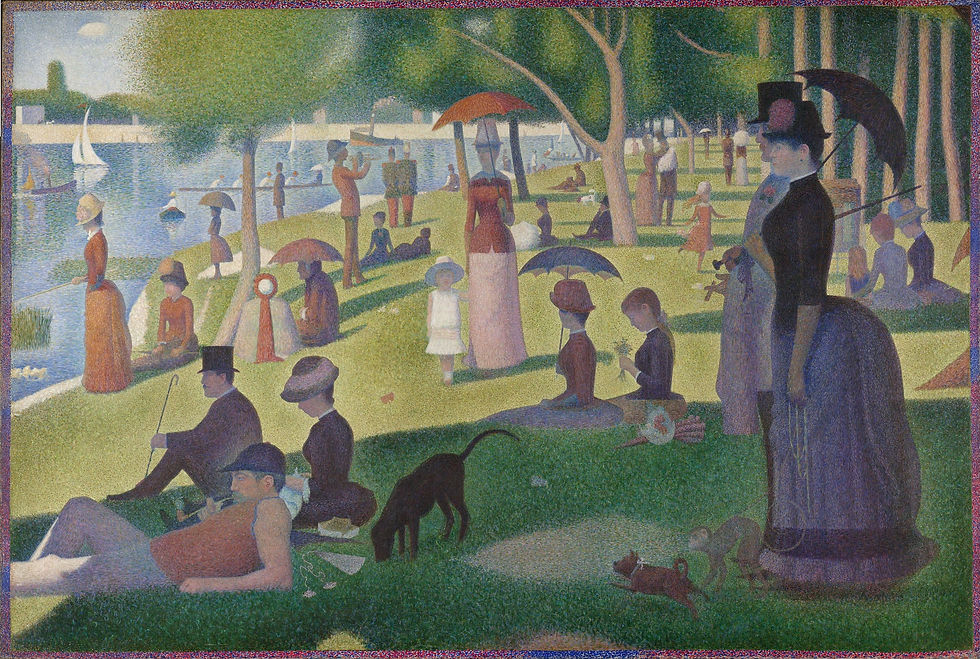
For collectors and reproduction painters, the lesson is equally practical: atmosphere depends on relationships, not on adding white everywhere. Preserve the darkest figure-to-sky contrast, separate the fog into subtly different values, and keep distant edges quieter than the foreground. Compare Friedrich’s staged viewpoint with Thomas Cole’s divided landscape in The Oxbow, El Greco’s expressive weather in View of Toledo, and Seurat’s controlled distance in La Grande Jatte. Each organizes looking differently.
Look again
Look again at the wanderer’s stance. Does he command the landscape, or does the fog reveal how little he can truly possess? The painting endures because it holds both possibilities at once—and makes our own position part of the answer.


Comments