
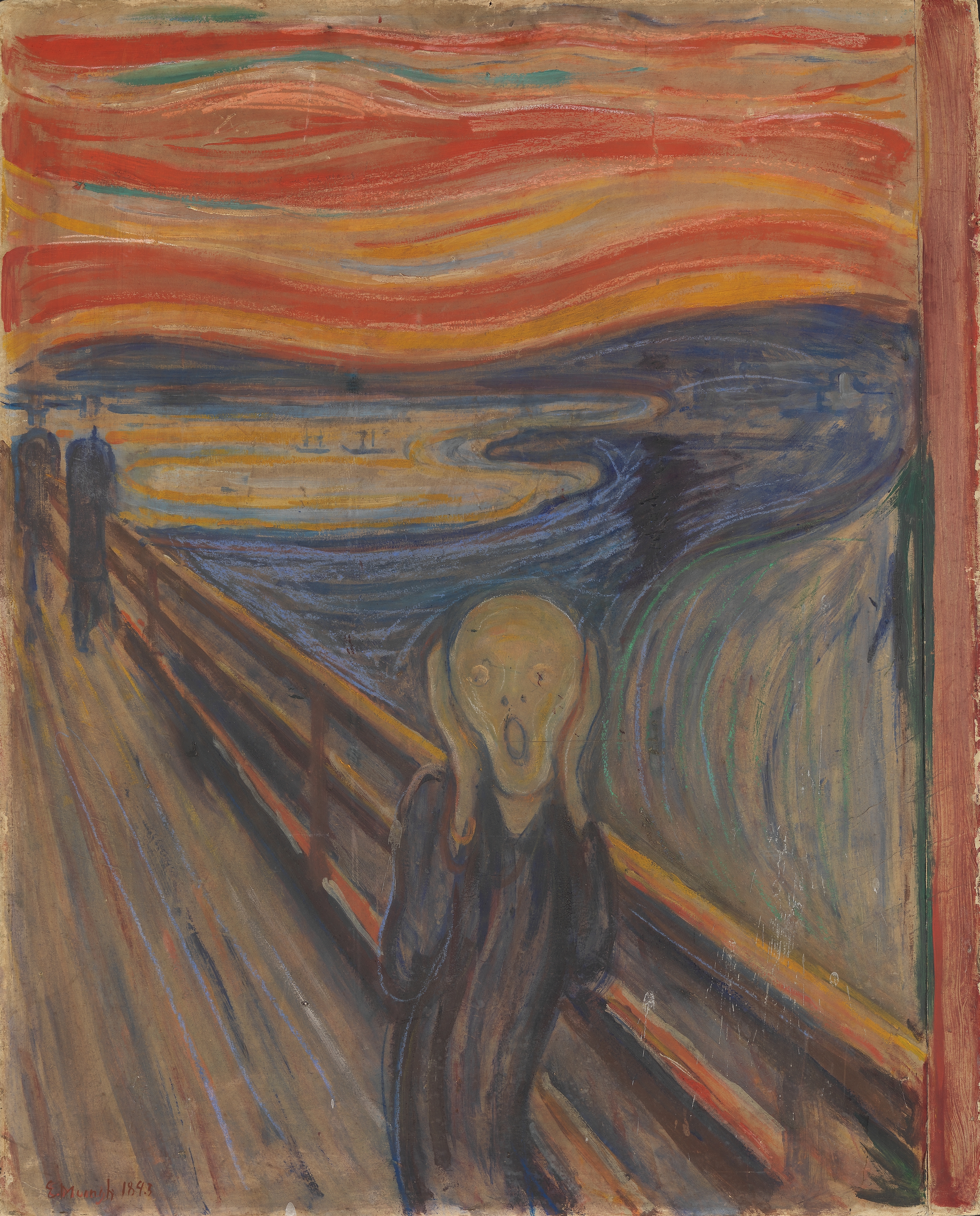
Edvard Munch’s The Scream: When One Image Has Many Originals

A pale figure stands on a bridge, hands pressed to its head, while the sky and fjord twist into bands of orange, blue, and green. Edvard Munch’s The Scream, painted in 1893, is not simply an image of fear; it is a study of how emotion can bend an entire landscape. The National Museum in Oslo identifies the work as tempera and wax crayon on cardboard, measuring 91 by 73.5 centimeters.

A landscape bent by emotion
Munch developed the motif after recalling an evening walk with two friends near the Oslo Fjord. In his written account, the sky turned blood-red and he sensed “a great and infinite scream through nature”. The distinction matters: the central figure may not be producing the scream at all. Its oval face, echoing mouth, and curved body seem to receive the vibration that rolls through water, hills, and sky.
The composition turns that sensation into structure. The bridge’s railing shoots backward in a hard diagonal, carrying the two distant walkers toward ordinary space. Against it, nearly every other line undulates. Thin, exposed-looking passages of cardboard, abrupt color shifts, and a shallow surface deny the polished finish expected of traditional painting. Munch makes instability visible.
One motif, several originals
Collectors often speak of “the original” Scream, but the history is more precise. MUNCH records four colorful versions made by the artist—two tempera paintings and two works in pastel or crayon—as well as a lithographic design circulated in multiple impressions. The National Museum owns the 1893 painting; MUNCH holds a later painted version, a drawing, and prints; another version remains privately owned.
These are not interchangeable copies. Each is an original object made or authorized within Munch’s practice, with its own date, medium, dimensions, condition, provenance, and catalogue identity. Repetition was part of his method: a motif could migrate between text, painting, drawing, and print while changing character.
Past and Present: learning from the object
Within CanvasNoble’s Past, the 1893 painting matters as a specific physical artifact. Cardboard gave Munch speed and directness, but it also made the work vulnerable. MUNCH limits light exposure for its paper- and cardboard-based versions because illumination can fade pigments and weaken their supports. Conservation is therefore not separate from meaning: the fragile surface records the urgency of its making.
Its Present is everywhere—from film and posters to an emoji—yet familiarity can flatten difference. A thoughtful collector asks: Which version? Which medium? What ownership history? Is it a lifetime print, a later edition, or a modern image?
That clarity is essential to Reproduction. A newly hand-painted interpretation can study Munch’s sweeping contours and color rhythm, but it must be described as a reproduction, never as an artist-made version. Its value lies in contemporary craftsmanship and transparent labeling, not borrowed authenticity.
Look again
Follow the straight railing, then compare it with the waves of the sky. Does the figure appear to scream—or to shield itself from a world already screaming?


Comments