
Bellini and Titian’s The Feast of the Gods: A Masterpiece Rewritten


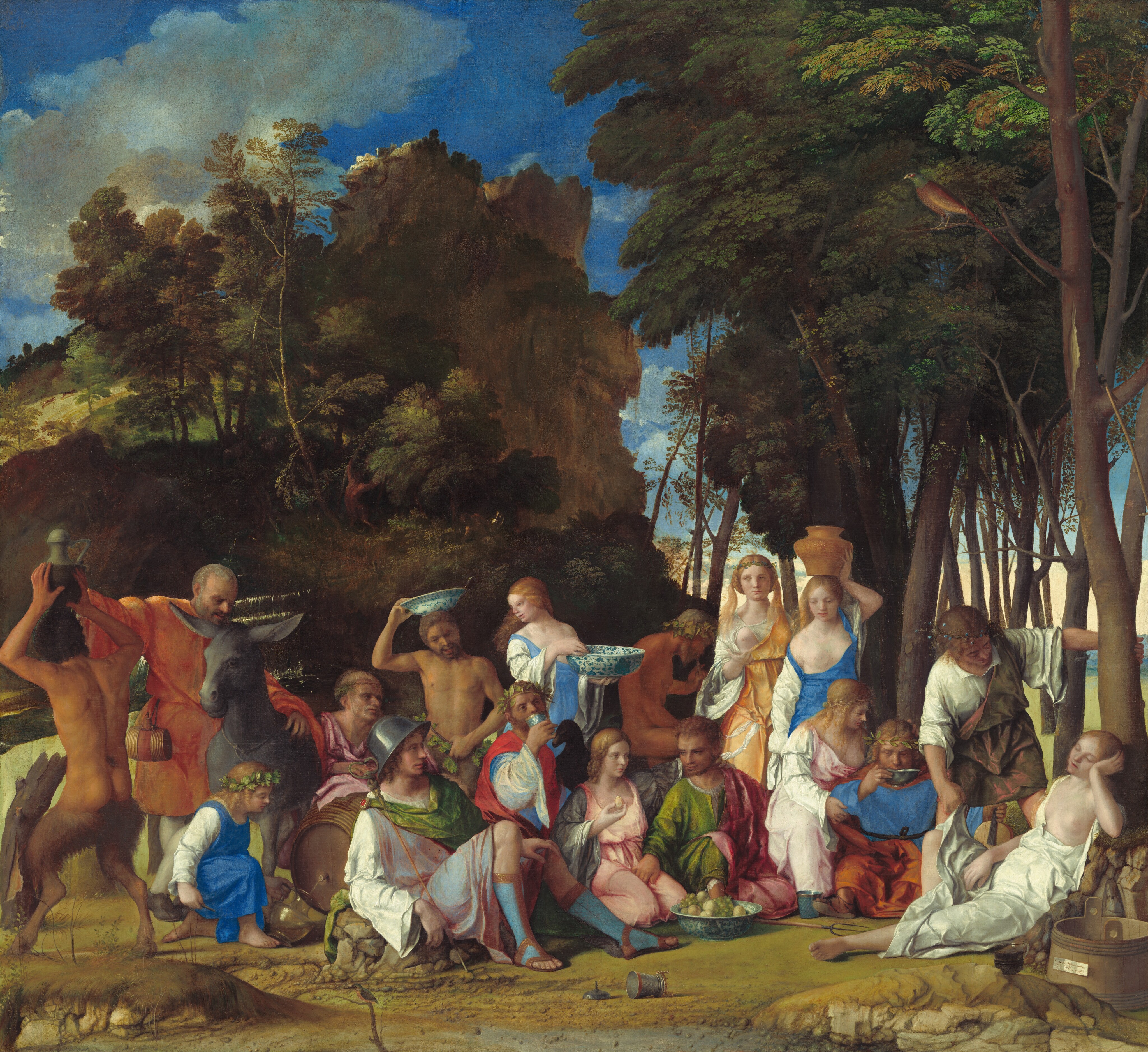
Giovanni Bellini and Titian, The Feast of the Gods, 1514–1529, oil on canvas, National Gallery of Art, Washington, Widener Collection. Image: Courtesy National Gallery of Art, Washington; CC0/Public Domain.
Giovanni Bellini’s The Feast of the Gods began in 1514 and reached its present form around 1529. Painted in oil on canvas and now in the National Gallery of Art, Washington, it is both a Renaissance masterpiece and a record of artistic revision. Bellini established the gathering; Dosso Dossi and Titian later altered its landscape. The result asks an unusually modern question: when several hands shape one surface, where does authorship reside?
A Painting With More Than One Author
Alfonso I d’Este commissioned the painting for the camerino d’alabastro, his private room in Ferrara. It opened a cycle of mythological bacchanals designed for courtly viewing. The National Gallery’s collection record identifies the gods, nymphs, satyrs, glassware, fruit, and the paper label bearing Bellini’s name and date.
After Bellini’s death in 1516, the setting changed. Conservation research, summarized in the museum’s Layers of Power feature, has helped reconstruct an earlier landscape beneath the visible one. Dossi probably revised parts of the foliage; Titian later introduced the craggy mountain and broader atmospheric setting, likely to harmonize Bellini’s picture with other works in the room.
Looking Past the Party
The scene comes from Ovid’s Fasti. At the right, the sleeping nymph Lotis is unaware that Priapus is lifting her gown; the donkey at the left is about to bray and interrupt him. The episode is comic in the ancient poem, but today it also prompts a necessary discussion about consent, power, and the habits of elite spectatorship. The museum’s audio tour explains how easily the picture’s color and still-life brilliance can distract viewers from its subject.
Bellini arranges the figures like a richly woven frieze. Pinks, blues, whites, and greens move across the foreground, while glazed vessels, porcelain-like bowls, fruit, and textiles advertise Ferrara’s access to luxury goods. Titian’s darker rock and high trees deepen the space and raise the visual pressure behind the relaxed gathering. His intervention does not erase Bellini; it changes the emotional climate around Bellini’s figures.
Technique, Time, and Attribution
For collectors, the painting offers a valuable lesson: alteration is not automatically damage, and authenticity is not always the same as untouched condition. Technical examination, provenance, inscriptions, and comparison with related works can reveal a layered object whose history is part of its meaning. The Metropolitan Museum’s overview of Titian helps place his color and painterly freedom within the wider Venetian tradition.
Past, Present, and Reproduction
CanvasNoble’s Past focuses on authenticated works by deceased artists, where attribution and material evidence remain essential. The Present asks how living artists reinterpret inherited images and shared authorship. Reproduction adds another distinction: a newly hand-painted interpretation may study historic color or composition, but it must never be confused with the original object, its age, or its provenance.
For artists now, The Feast of the Gods demonstrates that revision can be dialogue rather than defeat. For viewers, it rewards switching between surface pleasure and historical scrutiny. Look again: do your eyes stay with Bellini’s luminous figures, or does Titian’s darker landscape quietly rewrite the entire gathering?


Comments